
Introduction
Horizon Aircraft, a Canadian aerospace company headquartered in Lindsay, Ontario, is pushing the boundaries of aviation with its innovative Cavorite X7, a hybrid-electric vertical takeoff and landing (eVTOL) aircraft. Designed to blend the agility of a helicopter with the efficiency and speed of a conventional fixed-wing airplane, the Cavorite X7 is poised to make a significant impact on the emerging drone taxi market and the broader aviation industry. With its unique fan-in-wing technology, impressive performance metrics, and focus on safety and versatility, the Cavorite X7 aims to redefine regional air mobility, emergency services, and commercial applications.
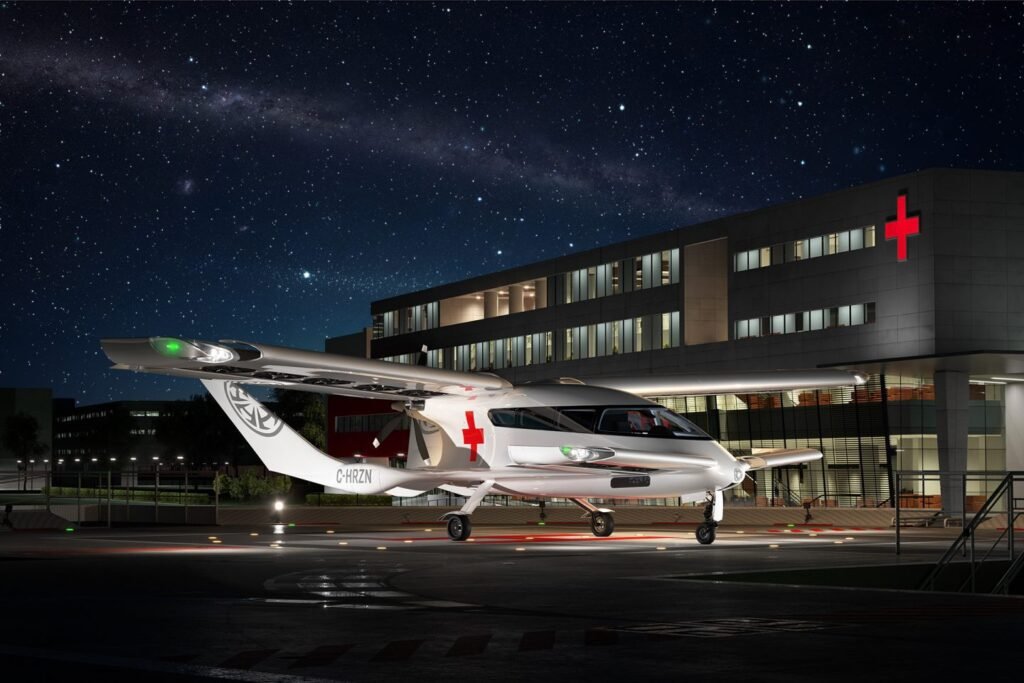
Image credits: horizonaircraft.com
The Cavorite X7: Design and Features
The Cavorite X7 is a seven-seat hybrid-electric eVTOL aircraft (one pilot and six passengers) with a patented fan-in-wing design that sets it apart from competitors. This innovative system features 14 lift fans embedded within the aircraft’s wings, which provide the thrust needed for vertical takeoff and landing. Once airborne, sliding panels conceal the fans, allowing the aircraft to transition seamlessly into forward flight, where it operates like a traditional fixed-wing plane, powered primarily by a rear pusher propeller. This hybrid approach enables the Cavorite X7 to combine the vertical lift capabilities of a helicopter with the speed, range, and efficiency of a conventional aircraft.
Key performance specifications of the Cavorite X7 include:
- Speed: Up to 350 km/h (217 mph), significantly faster than many competing eVTOLs.
- Range: Approximately 500 km (310 miles), offering substantial reach for regional missions.
- Payload: A capacity of 680 kg (1,500 lbs), making it suitable for passengers, cargo, or specialized equipment.
- Sustainability: The hybrid-electric system reduces hydrocarbon emissions by up to 30% compared to traditional aircraft performing similar missions, with potential for full electrification as battery technology advances.
The aircraft’s forward-swept wings enhance cabin space, improve handling during hover, and support urban operations by optimizing safety for bystanders. The design prioritizes operational versatility, allowing the Cavorite X7 to land on conventional runways, helipads, or even areas as small as a tennis court. Its ability to operate in adverse weather, including known icing conditions, further distinguishes it as a robust solution for real-world applications.
Impact on the Drone Taxi Industry
The drone taxi market, part of the broader Advanced Air Mobility (AAM) sector, is rapidly evolving as urban congestion and demand for efficient regional transport grow. The Cavorite X7 is well-positioned to disrupt this market by offering a practical and commercially viable solution for regional air mobility.
1. Enhanced Range and Capacity
Unlike many eVTOL designs focused on short urban hops, the Cavorite X7’s 500 km range and seven-seat capacity make it ideal for inter-city travel and regional connectivity. This extended range allows it to serve underserved areas, connecting remote regions to urban centers without the need for extensive ground infrastructure. Potential customers, including medevac services, business aviation, and commercial cargo operators, have expressed interest in larger aircraft like the X7 due to lower per-seat-mile costs, which align with their operational needs.
2. Hybrid-Electric Advantage
The Cavorite X7’s hybrid-electric propulsion system addresses a key limitation of fully electric eVTOLs: battery weight and range constraints. By relying on a hybrid system, the X7 avoids the need for heavy lithium-ion batteries, which can weigh over 2,000 lbs in competing designs and contribute to significant environmental impacts during production. Horizon Aircraft’s approach reduces emissions by up to 30% compared to traditional aircraft, offering a more sustainable alternative while maintaining performance. As battery technology improves, the X7 is designed to transition to full electrification, ensuring future-proofing for greener operations.
3. Versatility for Urban and Rural Applications
The Cavorite X7’s ability to take off and land vertically or on conventional runways makes it highly adaptable. In urban environments, it can operate from compact landing zones, supporting drone taxi services for business travelers or emergency response teams. In rural or remote areas, its range and payload capacity enable applications like medical evacuations, disaster relief, and cargo delivery. This flexibility positions the X7 as a multi-role platform, capable of serving diverse markets within the drone taxi ecosystem.
Impact on the Broader Aviation Industry
Beyond drone taxis, the Cavorite X7 has the potential to transform multiple sectors of the aviation industry, from emergency services to military applications.
1. Emergency Services and Medevac
The Cavorite X7’s speed, range, and agility make it an ideal candidate for medical evacuation (medevac) and disaster relief missions. Its ability to access remote or disaster-stricken areas up to twice as fast as conventional helicopters could save critical time in transporting injured patients, organs, or medical supplies. The aircraft’s spacious cabin and payload capacity further enhance its suitability for these high-stakes missions, potentially revolutionizing emergency response capabilities.
2. Military and Special Operations
Horizon Aircraft has identified significant interest from military customers for the Cavorite X7’s use in special operations, such as aerial firefighting, search and rescue, and surveillance. Its fan-in-wing design and hybrid propulsion system provide the durability and versatility needed for demanding missions, while its ability to operate in all-weather conditions ensures reliability in challenging environments. The aircraft’s cost-effective design could also make it an attractive option for government agencies seeking advanced yet affordable solutions.
3. Sustainable Aviation
The aviation industry is under increasing pressure to reduce its environmental footprint. The Cavorite X7’s hybrid-electric system offers a practical step toward sustainability, reducing emissions compared to traditional aircraft. Horizon Aircraft is also exploring future integration of hydrogen and advanced battery technologies, signaling a commitment to long-term environmental responsibility. By demonstrating that high-performance eVTOLs can prioritize sustainability without sacrificing utility, the X7 could set a new standard for eco-conscious aviation.
Challenges and Future Outlook
While the Cavorite X7 shows immense promise, Horizon Aircraft faces challenges common to the eVTOL industry, including regulatory hurdles, certification processes, and the need for additional capital to scale production. The company’s recent business combination with Pono Capital Three, Inc., and its listing on NASDAQ (HOVR) provide financial backing to support development, but successful certification and market entry will be critical.
Horizon Aircraft has already achieved significant milestones, including successful transition flights with a 50%-scale prototype and ongoing testing of its fan-in-wing technology. The company is now 75% through the design of its full-scale prototype, with plans to complete testing and certification before scaling production to meet demand from regional operators, emergency services, and military clients.
Conclusion
Horizon Aircraft’s Cavorite X7 represents a bold step forward in the eVTOL and aviation industries. Its hybrid-electric design, impressive range, and versatile applications make it a standout in the drone taxi market, while its potential in emergency services, military operations, and sustainable aviation broadens its impact. By prioritizing safety, performance, and commercial viability, Horizon Aircraft is well-positioned to lead the charge in regional air mobility and redefine how people and goods move across the skies. As the Cavorite X7 progresses toward certification and production, it could herald a new era of accessible, efficient, and environmentally conscious aviation.